
Five Marble Mistakes That Cost Thousands — A London Designer's Guide to Specifying Stone

After twenty years of specifying stone for luxury residential projects across London and Europe, I've come to a conclusion that surprises most clients: the difference between a marble bathroom that looks extraordinary and one that quietly disappoints rarely comes down to the marble itself. It comes down to how the marble was chosen.
The mistakes are predictable. They happen at the same five points in almost every project. And because the consequences only appear after the slabs are installed — after the budget is spent, the bathroom is finished, the client has moved in — the lessons are usually learned the expensive way.
This article is for clients about to specify stone for the first time, and for anyone who has been disappointed by a previous project and isn't quite sure where it went wrong. I'm writing it because at Supremati we've turned down work where the existing brief would have led directly to one of these mistakes, and I think the conversation is more useful in public than behind closed doors.
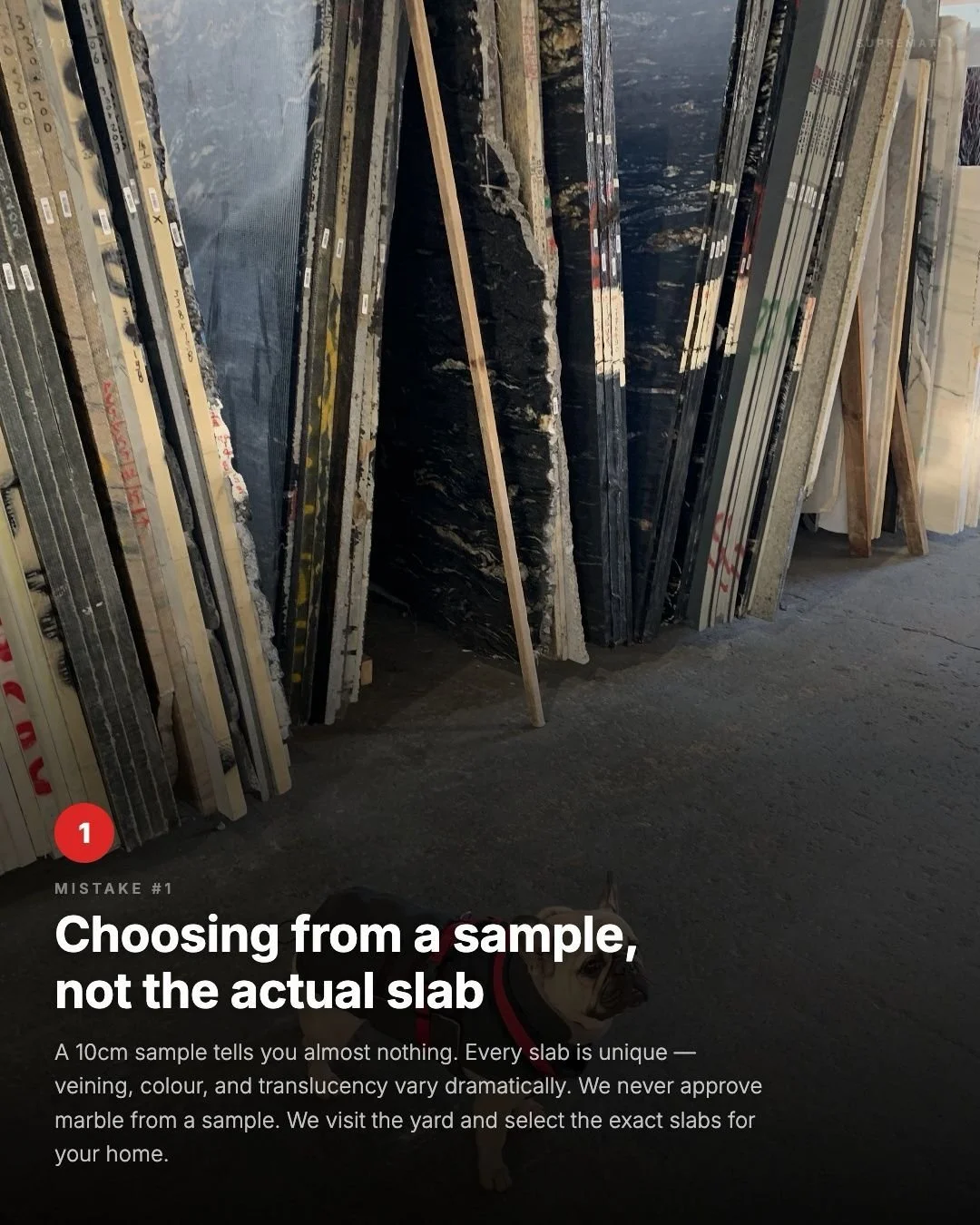
Mistake 1 — Choosing from a sample, not the actual slab
A ten-centimetre sample tells you almost nothing useful about marble.
Every slab is unique. Veining shifts. Colour saturation varies between blocks from the same quarry, sometimes even between slabs cut from the same block. Translucency — the quality that gives marble its depth and life — can change dramatically between two pieces that look identical in a tile shop.
We don't approve marble from a sample. Ever. We visit the yard or the quarry, walk between the slabs, and select the exact pieces for the project. On a recent project in central London, the client's initial sample preference would have produced a bathroom that read entirely differently from what they wanted — the slab itself had a vein break and a grey undertone that the sample didn't show. We chose two slabs from a different block, and the room is now exactly what was intended.
If your designer is specifying marble from samples alone, ask them why.
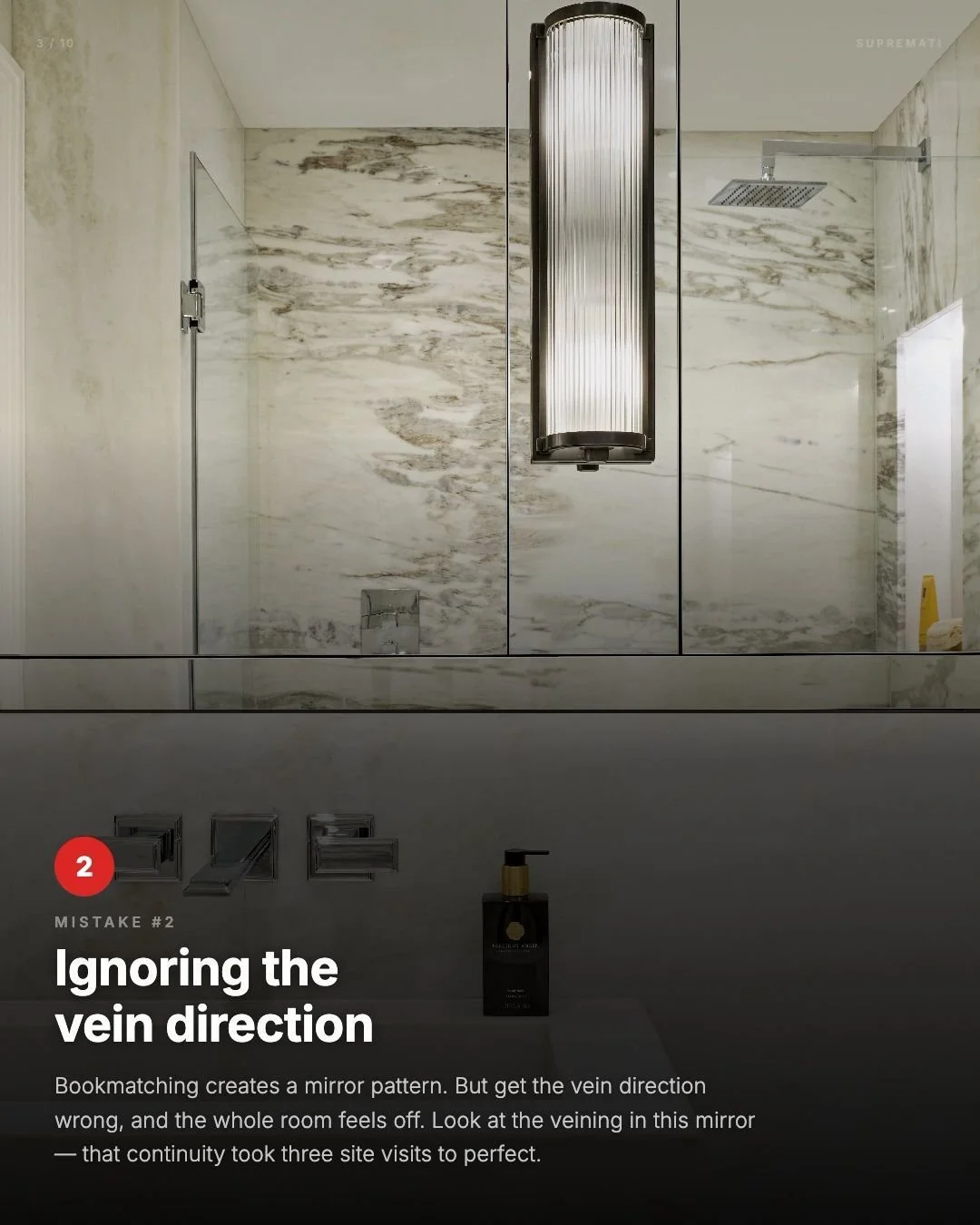
Mistake 2 — Ignoring the vein direction
Bookmatching is one of the most beautiful things you can do with stone. Two adjacent slabs are cut and opened like a book, creating a mirror pattern that makes a room feel composed and intentional.
When it's done well, you don't notice the technique. You just notice that the room feels resolved.
When it's done badly, the room feels off and most people can't tell you why. The vein direction doesn't flow. The mirror pattern is slightly out of register. The eye picks up the inconsistency long before the brain articulates it.
Getting bookmatching right takes three things: selecting the slabs in person so you know which two will mirror, planning the cuts before installation begins, and visiting site during installation to confirm the pattern. On a Mayfair project last year, this took three separate site visits to perfect. The result is a shower that photographs beautifully and, more importantly, feels right when you stand in it.
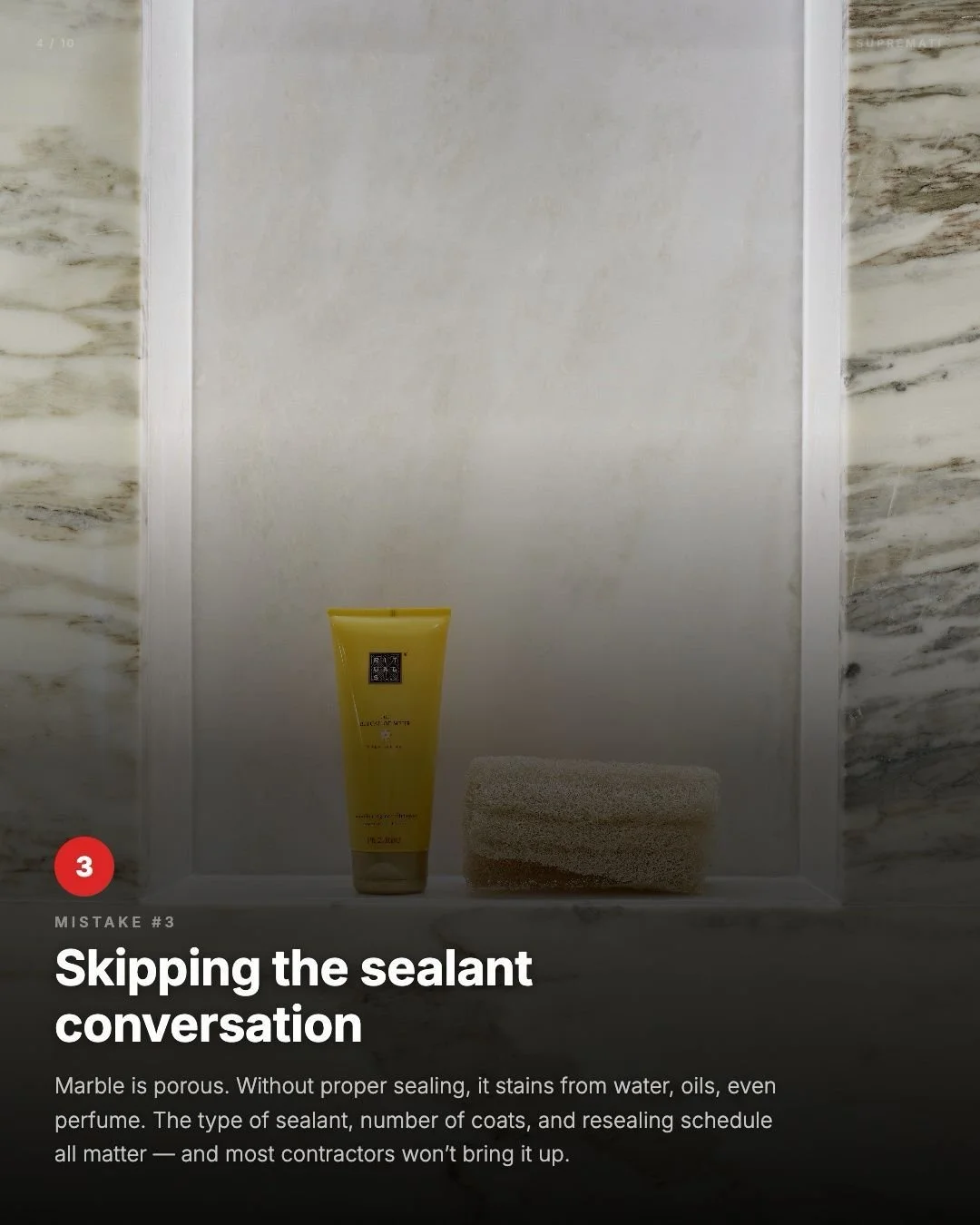
Mistake 3 — Skipping the sealant conversation
Marble is porous. Without the right sealant, applied properly and refreshed on schedule, it stains. Water rings. Oil marks. Perfume. Toothpaste. Even cosmetics left on a surface overnight can leave a permanent shadow.
Most contractors won't bring this up unless asked. Some apply a single coat of generic sealant and consider the conversation closed. The result, two years in, is a bathroom the client is afraid to actually use.
The right conversation covers three things: which sealant suits the specific marble (different stones absorb differently), how many coats are needed at installation, and what the resealing schedule should be. For most marble bathrooms, that's a fresh seal every two to three years. For kitchens, often annually. Without this planning, you're not buying a marble surface — you're buying a maintenance problem dressed up as luxury.
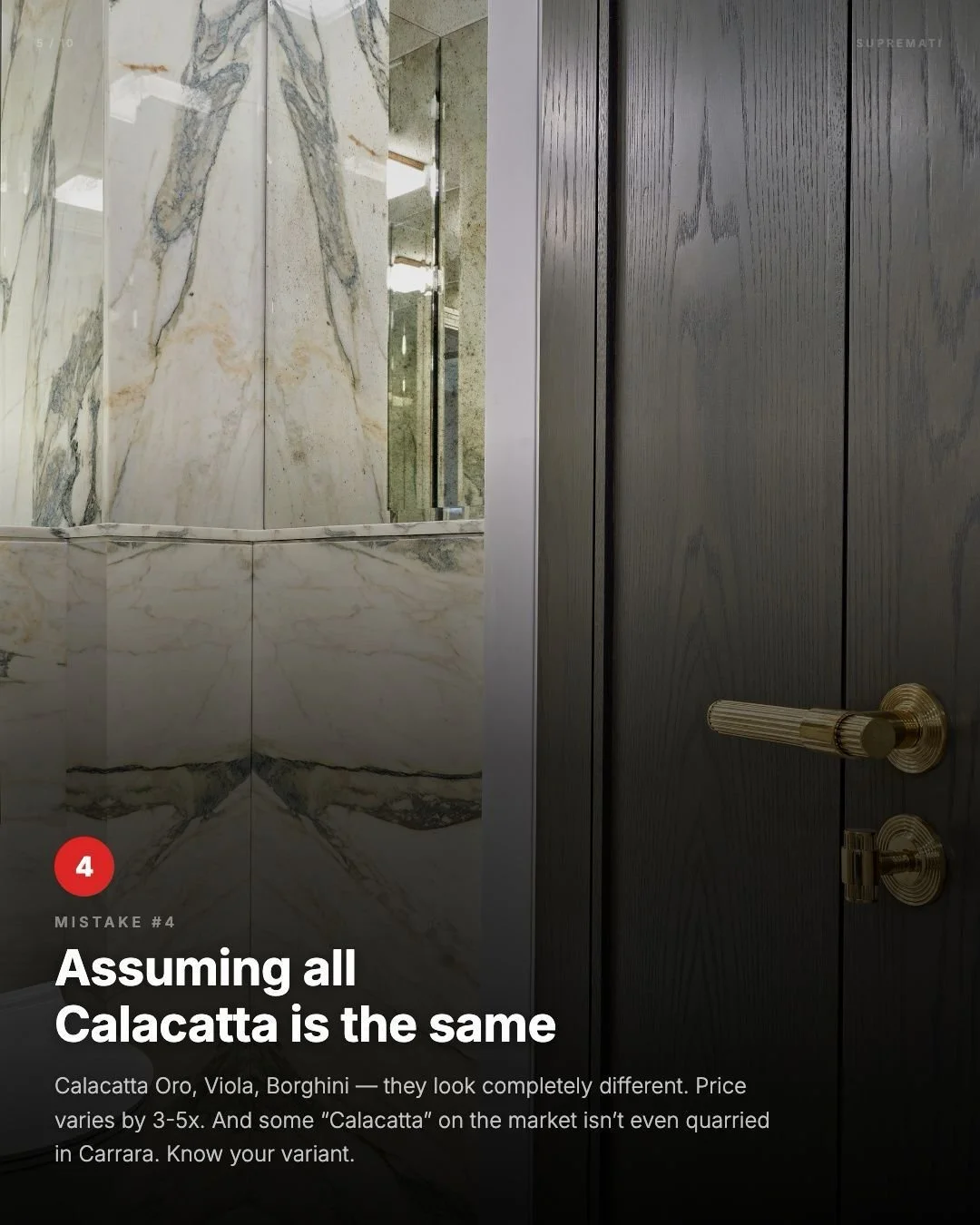
Mistake 4 — Assuming all Calacatta is the same
Calacatta is a category, not a material. Calacatta Oro, Calacatta Viola, Calacatta Borghini, Calacatta Vagli — these read as completely different stones to anyone trained to look. The veining, the background warmth, the rarity, and the price all vary.
And here is the part most clients don't know: some stone marketed as "Calacatta" isn't quarried in Carrara at all. The name has become loose. There are Turkish marbles, Chinese marbles, and engineered surfaces all sold under names that imply Italian provenance.
For a luxury project, this matters. Not for snobbery, but because the materials behave differently. They age differently. They take light differently. A specifier who can't tell you the exact quarry of origin for a slab they've recommended is a specifier whose recommendation is built on a sample card, not on stone.
Know your variant. Ask where it's quarried. Ask to see the certificate of origin from the quarry. A reputable supplier provides this without hesitation.
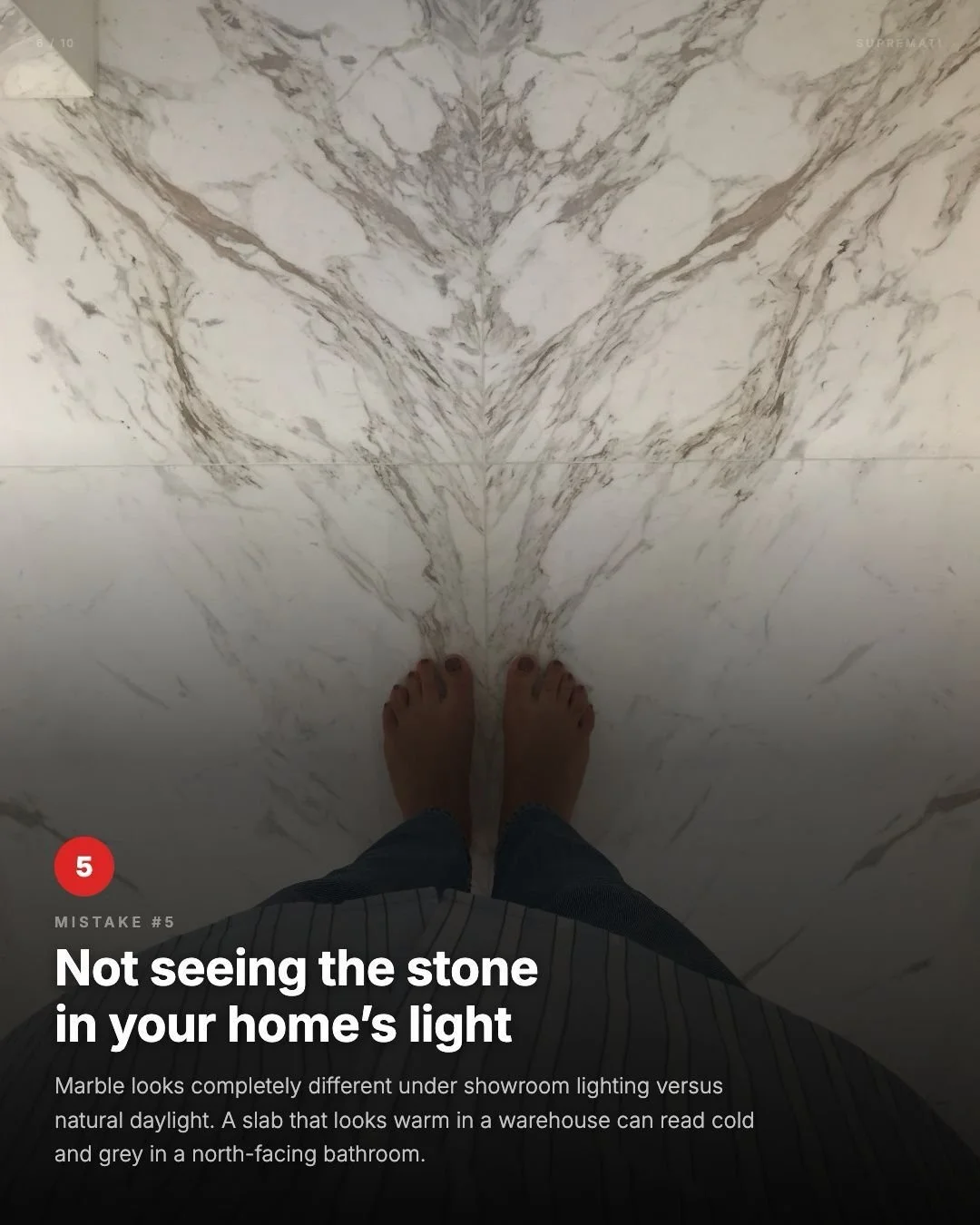
Mistake 5 — Not seeing the stone in your home's light
Marble looks completely different under showroom lighting than it does in natural daylight. A slab that reads warm and golden under a yard's halogen spots can look cold and grey in a north-facing London bathroom. A piece that seems calm and subtle in fluorescent light can read busy and active in direct sun.
We carry slab offcuts to site whenever possible. We hold the stone against the wall, in the actual room, at different times of day, before we approve anything for cutting. It's slower. It's the only way to know.
For clients who can't fly to Italy with us, we send slab samples ahead and ask them to live with them for a week — at breakfast, at dinner, in the morning light, under the lamps they actually use in the evening. The answer almost always reveals itself within forty-eight hours.
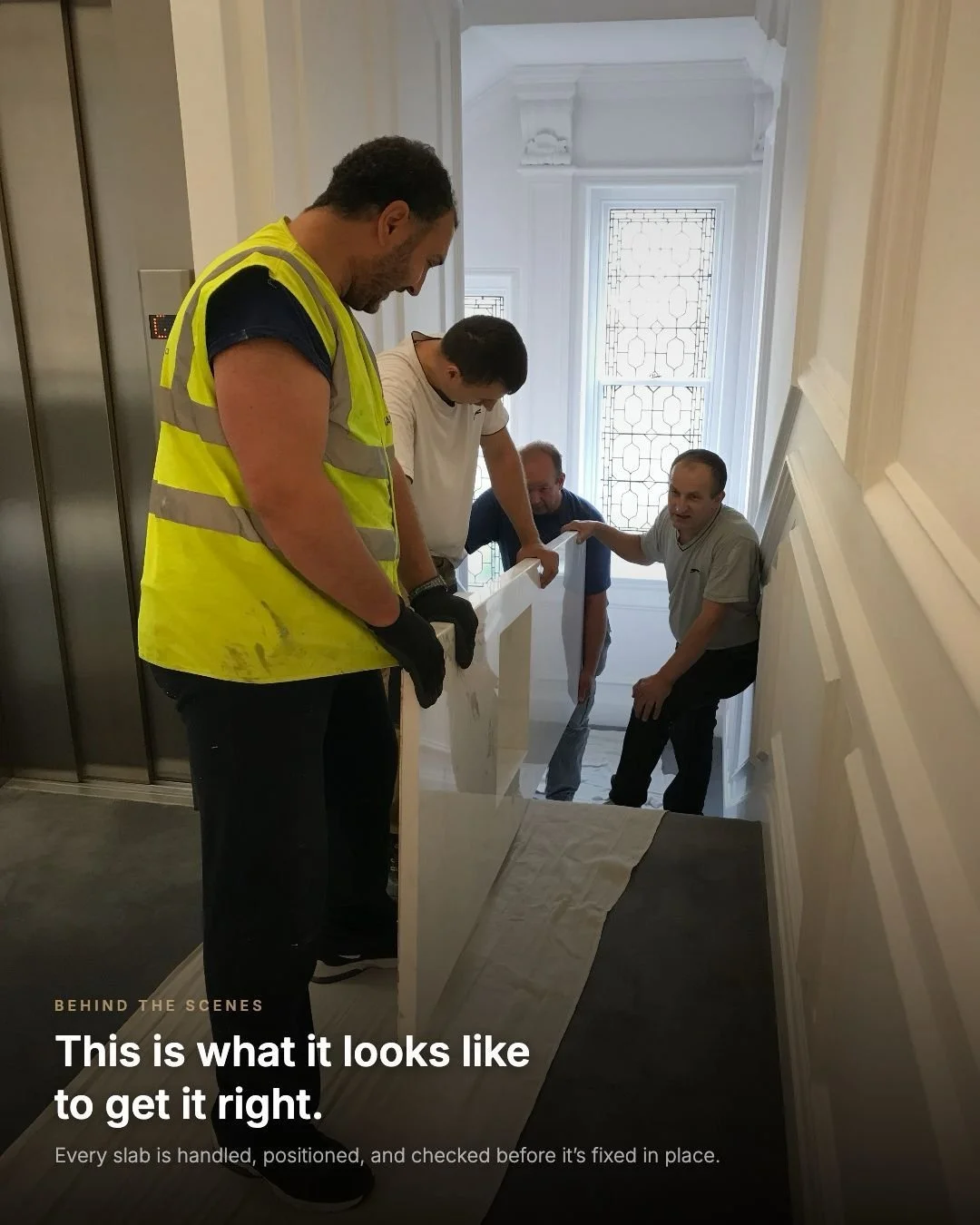
How we specify stone at Supremati
The pattern across all five mistakes is the same: shortcuts at the specification stage produce problems at the lived-with stage.
Our process is built to remove those shortcuts. We fly to quarries in Italy. We walk between the slabs. We photograph each one against natural light and against a neutral background, and we make our selection in person. We don't leave until it's right.
On site, we plan the cuts before installation begins. We brief contractors on vein direction, bookmatching, and grout lines down to the millimetre. We commission proper sealing, and we hand the client a maintenance schedule with their final documentation.
It's a more involved process than most studios run. It produces stone interiors that age well, photograph well, and — most importantly — feel right to live in for the next two decades.
See some of our completed projects with marble.
If you're planning a project that involves marble or natural stone and want a studio that takes the specification seriously, we'd be glad to talk. Contact us here.
““The difference between a kitchen that photographs well and one that feels right for decades is rarely the stone itself. It’s how the stone was chosen.” Pullquotes break up long articles visually and increase time-on-page, which Google reads as a positive signal.”

Mayfair kitchen by Supremati, featuring a full-height bookmatched marble wall. Slabs selected in person at Margraf, Italy.