Bespoke Curtains in London: The Five Decisions Behind Every Window
Curtains at this scale don't happen by accident.
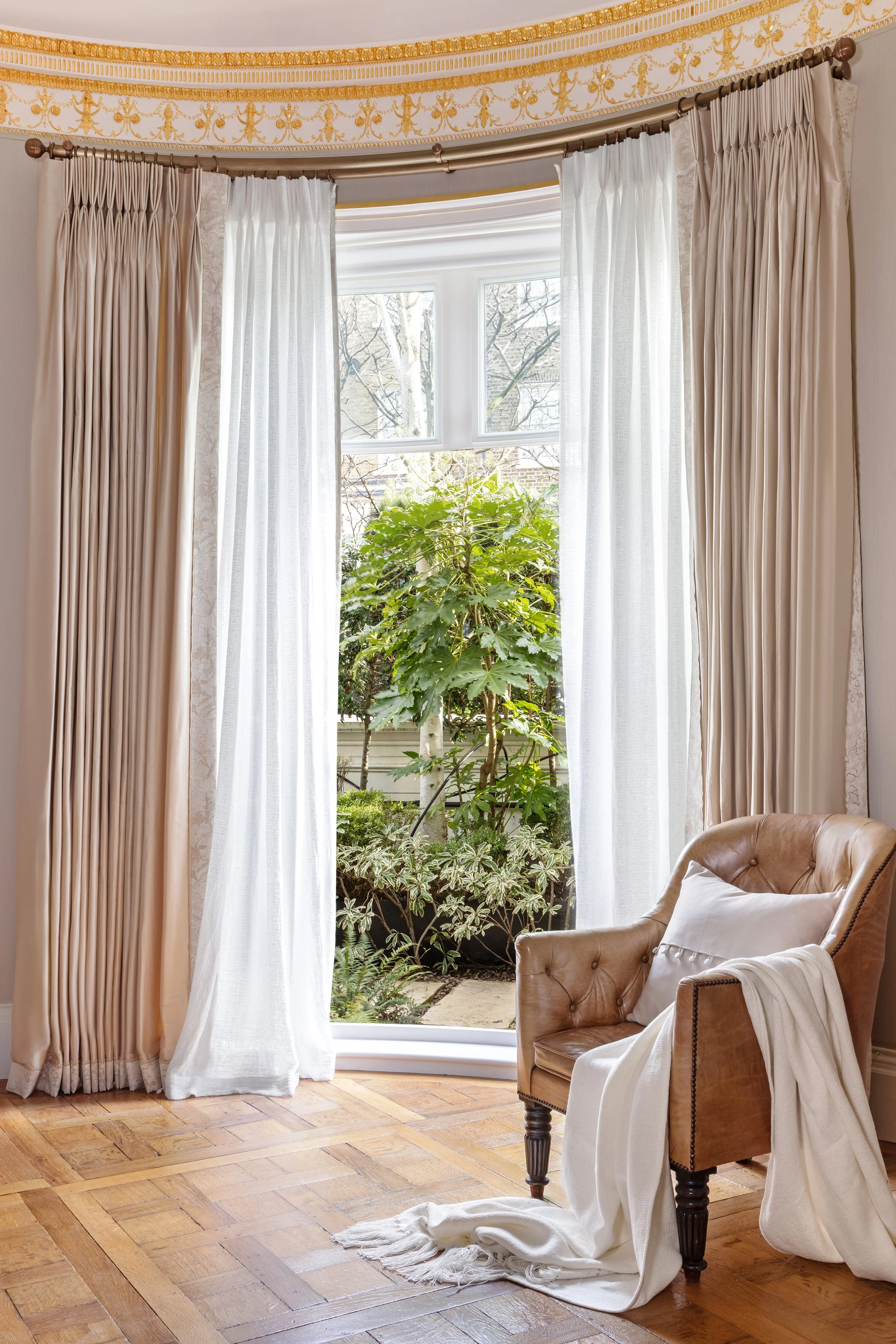
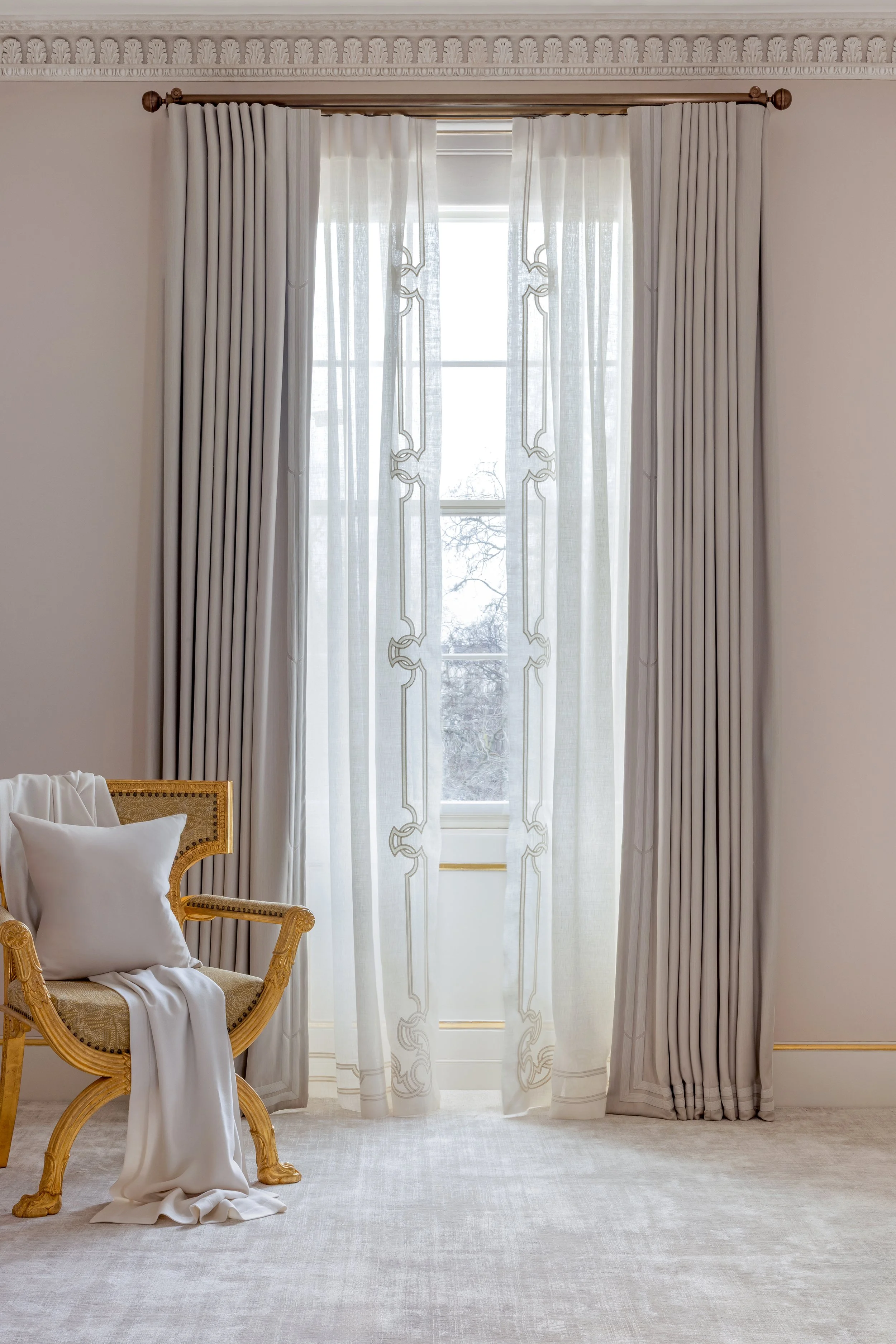
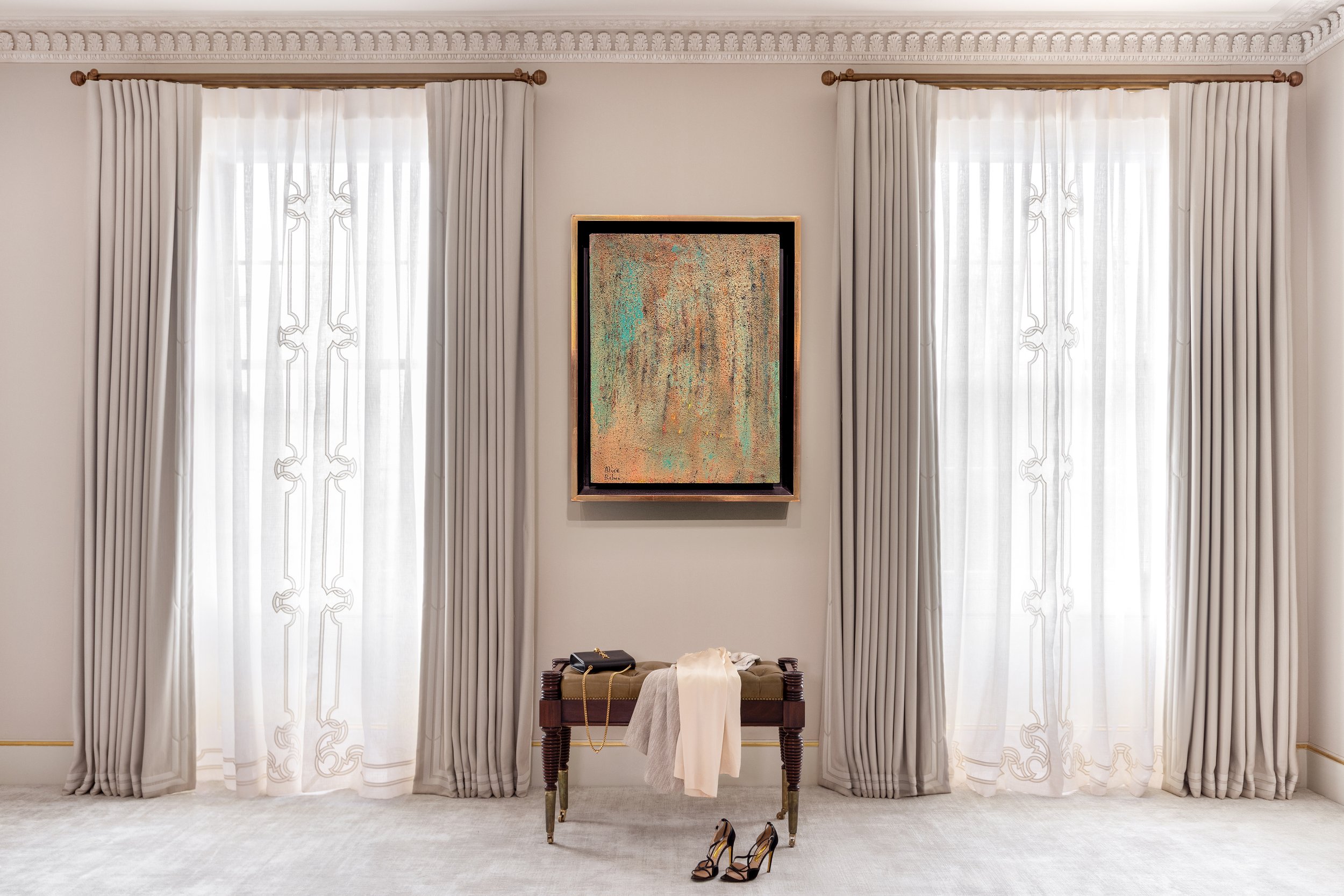
In a Grade I listed London dining room we completed recently, the windows run nearly the full height of the room — four metres — and the curtains had to hold their own against those proportions. We dressed them in a sage silk from Dedar, finished with a Zoffany border, hung on antique brass poles from Tillys. Behind them, sheers from De Le Cuona, with a vertical border to tie them back to the silk.
Fabric, border, pole, heading, sheer: five decisions most people will never notice. Which is exactly the point.
This piece is about who makes those five decisions, and why that matters more than who sews the hem.
A curtain maker and an interior designer are not the same commission
People searching for the best curtain makers in London are usually asking the right question in the wrong order.
A good London workroom is a remarkable thing. The best of them can hand-finish an interlined silk curtain to a standard that will outlast the building's next two owners. What a workroom does not do — and should not be asked to do — is decide what the window needs. It makes what it is given, to the measurements it is given.
That is the gap we fill. Supremati is an interior design studio: we design the window treatment, specify every component, and commission the workroom and the installers who execute it. We hold the drawing, the fabric schedule, the site survey and the responsibility. If the heading is wrong for the fabric weight, that is our mistake to have prevented, not the maker's to have guessed.
We don't publish the names of our workrooms. Those relationships took years to build and they are part of what a client is appointing us for.
It is a different purchase from ringing a maker directly. Going direct works well when you already know exactly what you want. Most of our clients don't want to spend their evenings learning the difference between a goblet pleat and a hand-gathered French pleat — they want the room to be right.
The substantive reason to appoint a designer rather than a maker, though, is not taste. It is that a window is never a self-contained object. A curtain or a Roman blind has to work with the joinery beside it, the cornice above it, the architrave around it, the shutters behind it, the radiator below it and the lighting across from it. A maker is given a window and a measurement. A designer is looking at the whole room, and at the half-dozen adjacent decisions that determine whether the treatment can physically work at all — which is where window treatments actually go wrong.
The five decisions
1. Fabric and weight
The fabric decides almost everything downstream. A four-metre drop in a light silk needs interlining to hang with any authority; the same silk at two metres may not. Weight also determines how much fabric gathers into the heading, which determines the pole, which determines the fixings — a chain of consequences that starts with one choice.
We work with the houses whose cloth behaves predictably at scale: Dedar, De Le Cuona, Holland & Sherry, Zoffany, Rubelli, Kvadrat. Not because the names are reassuring, but because we know how their fabrics fall, fade and clean.
2. The heading
The heading is where a curtain either looks designed or looks supplied. Pencil, French pleat, goblet, wave, hand-gathered — each reads differently at different heights and in different periods of architecture. A wave heading in a classical reception room is a jarring note most people will feel without being able to name.
3. Pole, track, pelmet — or a blind
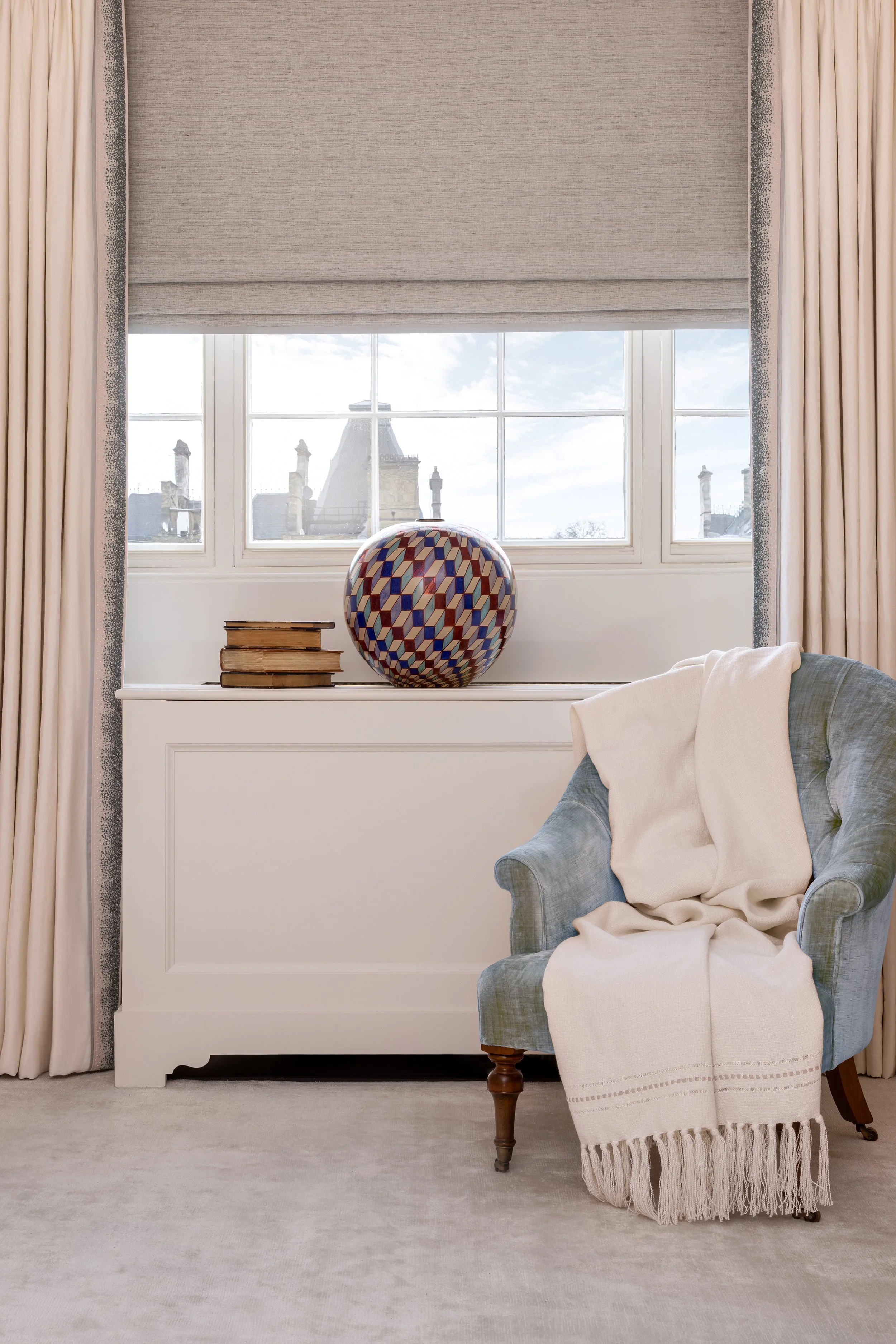
In a listed room the fixing is often the hardest part: you may not be able to put a bracket where the design wants one. Antique brass poles — ours come from Tillys — suit period rooms where the hardware is meant to be seen. Concealed tracks suit rooms where it isn't. A pelmet can rescue a window whose proportions are wrong, and ruin one whose proportions are right. And some windows don't want curtains at all: a Roman blind set inside the architrave can be the better answer, particularly where there is no wall to stack a curtain onto.
This is also the decision with the most physical consequences, and we come back to it below.
4. Borders and trims
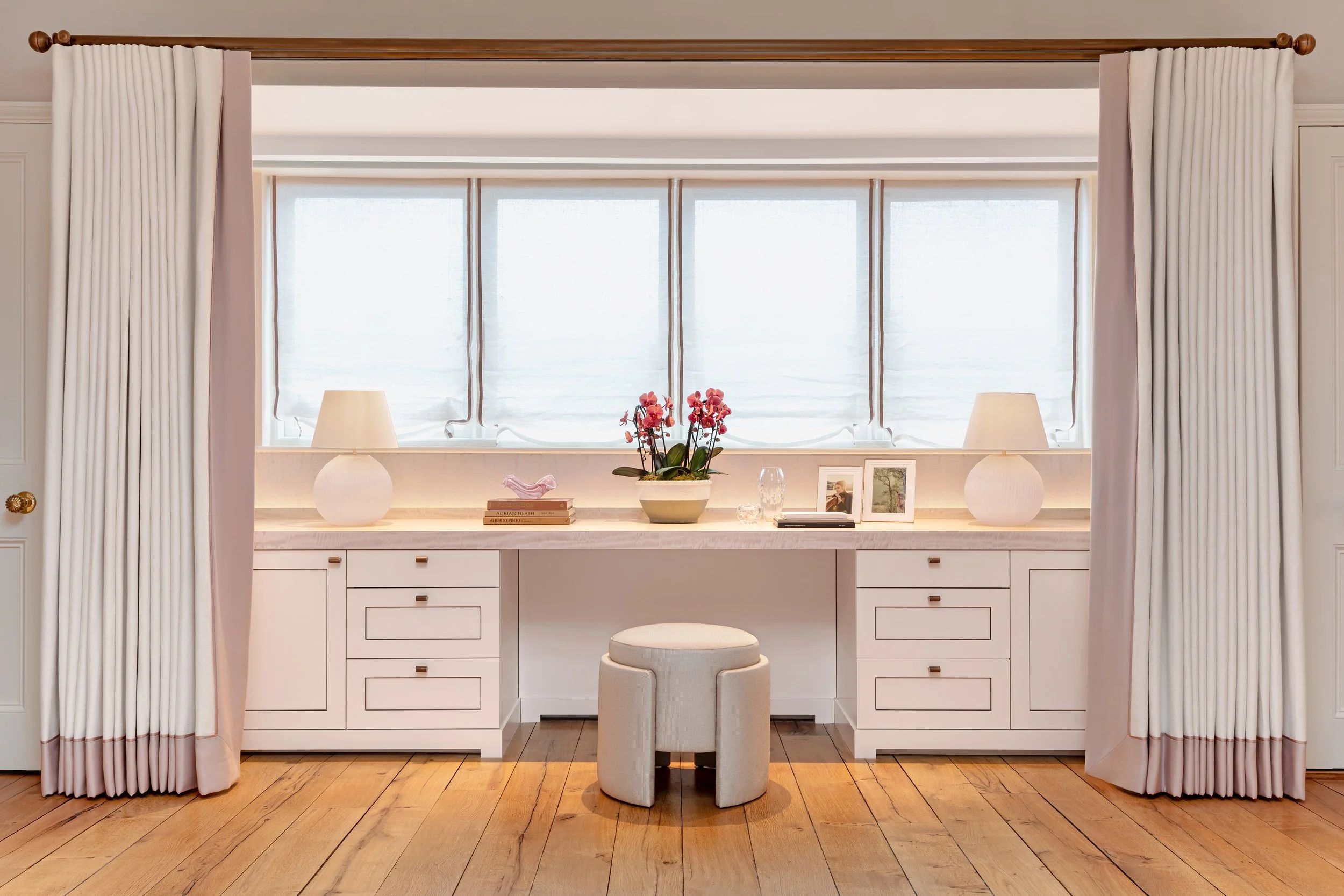
A hand-applied border is one of the most expensive decisions on a curtain, not one of the cheapest. It is applied by hand, it takes time, and the cost sits in the labour. A ready-made border or trim from a house like Samuel & Sons costs considerably less than a border made bespoke to the scheme — and adding a trim on top of a border multiplies the hand work again.
So the question is never only whether a border suits the curtain. It is whether this particular window is where that money should go. In the dining room above, a Zoffany border on the sage silk gave the drop a defined edge against a very tall wall; carrying a vertical border onto the sheers behind tied the two layers into one gesture rather than two. In a room with less height and less light, the same spend would have been better put into the fabric.
5. Sheers and layering
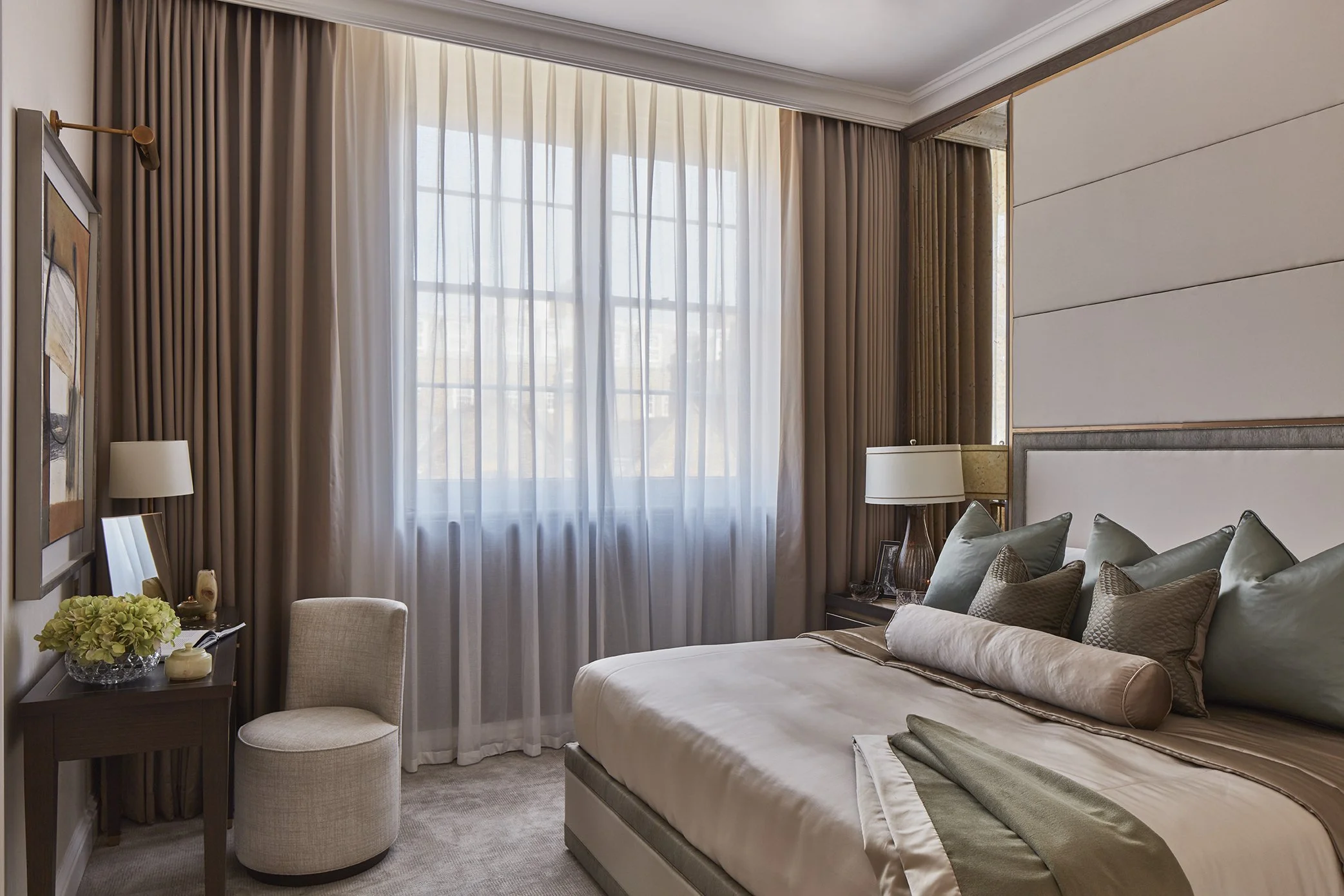
Sheers do the daily work: privacy at ground level, light softened at the top of the house, a second texture when the main curtains are open. Getting them to relate to the heavy curtain — in colour, in border, in heading — is what stops a window reading as two separate purchases.
In a listed building, curtains are architecture
In a listed or period property, window treatments are architecture as much as decoration. Get the scale, the heading or the fabric weight wrong and the whole room feels off, however good the joinery and the lighting are.
Fixings are frequently restricted. Reveals are rarely square. Secondary glazing, where it exists, changes the depth you have to work with. Shutters that are original to the house have to be allowed to open. None of this is solvable at the end of a project, which is why we design curtains from first concept — alongside the joinery, the lighting and the furniture plan — never as a finishing touch.
More on that balance in Designing for Belgravia: How to Honour a Period Property Without Freezing It in Time.
True blackout is an architecture decision, not a fabric one
Clients who ask for blackout usually mean it literally: no light, anywhere, at any hour. Blackout lining alone will not give them that. Light comes in at the top of the curtain and down the sides, and no amount of fabric specification closes those gaps.
Getting it right means building it into the architecture:
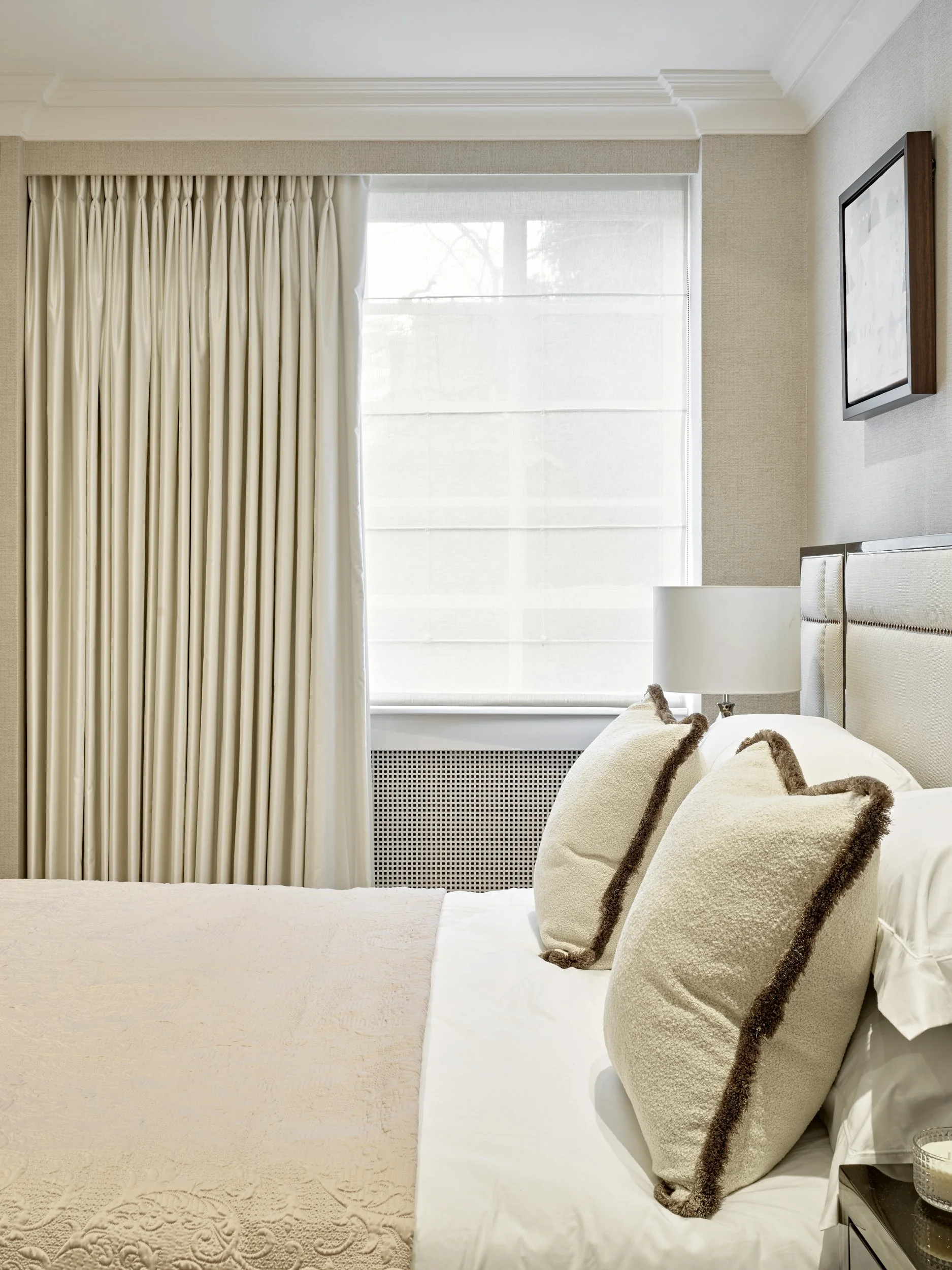
For curtains, the track is taken up to the ceiling, and the cornice runs in front of the curtain heading. The cornice conceals the track and closes the gap above the curtain, so there is nothing for light to come over. You cannot retrofit that relationship — the cornice and the track have to be designed together.
For Roman blinds, we use specialist blackout tracks fitted inside the architrave, with the blind itself set inside the architrave so the edges are enclosed rather than overlapped. That detail is what turns a Roman blind from a light-reducing treatment into a genuinely dark room.
Both are decisions about the joinery and the plaster, not about the cloth. Which is the real argument for appointing us for the whole scheme: when the curtains, the cornice, the joinery and the lighting are drawn by the same hand, blackout is simply a consequence of the design rather than a problem to be solved at the end.
If the house is already finished
Not every client comes to us at concept stage. Often the property has already been refurbished — by a developer, or to another designer's scheme — and the windows are the piece that was never resolved.
We take those commissions. It is a survey-led exercise rather than a design-led one: we attend site, measure every window, establish where the cornice sits and how much depth there is to work with, and then judge whether this window wants curtains or a Roman blind, and whether the pole or track should be fixed to the ceiling or to the architrave.
The constraints in a finished house are real and they are usually invisible on a drawing. A common one: a window sitting very close to a joinery door. Specify blackout curtains with sheers behind, and the pole and its brackets can project almost 20 centimetres into the room — enough to stop the joinery door opening. Nobody discovers that until the curtains are hung, unless someone has stood in the room and thought about it first.
So the work is to make new window treatments behave as though they had always been part of the house: working with the cornice that exists, the architraves that exist, and the joinery somebody else has already installed.
How the process actually runs
Survey. Every window measured on site, with the reveals, fixing points, floor levels and any listed fabric recorded. Measurements are never taken from drawings alone.
Design. Elevations for each window, with heading, drop, stack, pole or track, pelmet and layering drawn — not described.
Specification and approval. Fabric, lining, interlining, border, heading, hardware and finish, as a written schedule. You see and handle the actual cloth before anything is cut.
Workroom. The order is placed with the workroom we judge right for that fabric and that scale, and we hold the programme against the wider site schedule.
Installation and dressing. Fitted and dressed on site, usually by the installers we work with regularly, and corrected on the day if the room disagrees with the drawing.
Allow six to ten weeks from fabric approval to installation. Where a client is working to a fixed date — a completion, a move-in, a family arriving — we can often compress that, by sequencing the order differently and by choosing fabrics and workrooms against the deadline rather than against the ideal. It is worth asking rather than assuming.
If you are not in London
A good share of our work is for clients who are not in the country — developers, and private owners whose London house is one of several. Curtains are one of the easiest elements to commission remotely, because the decisions are discrete and can be approved one at a time: fabric samples couriered out, elevations and fabric schedules approved by email, progress photographed on site, installation attended by us rather than by you.
How that works across a whole project is set out in For Clients Who Can't Be on Site — Working with Developers and Overseas Owners.
Questions we are asked
Do you make the curtains yourselves? No. We design and specify them, and commission the London workrooms that make them. The design, the specification and the site responsibility sit with us; the hand-finishing sits with makers who do nothing else.
Can I just use my own curtain maker? Yes, often. If you already have a workroom you trust, we will design to them and work with them. What we won't do is hand over a window without a drawing and a specification.
Why appoint an interior designer rather than a curtain maker? Because a window is not a self-contained object. The treatment has to work with the joinery, the cornice, the architraves, the shutters and the lighting around it — and whether it can work at all is often decided by those things rather than by the curtain. A maker is given a window and a measurement. We are looking at the whole room.
Do you only do curtains as part of a full scheme? Ideally, yes — true blackout in particular has to be designed alongside the cornice and the joinery, so the whole scheme is where we add most. But we also take on window treatments in houses that are already finished, including those refurbished by a developer or designed by someone else. In that case we attend site, measure every window, establish where the cornice and architraves sit, and design the treatment to work with the joinery that already exists.
Can you achieve full blackout? Yes, but not with lining alone — light comes over the top of a curtain and down its sides. For curtains, the track is taken to the ceiling with the cornice run in front of the heading to close the gap above. For Roman blinds, specialist blackout tracks are fitted inside the architrave with the blind set inside it. Both are architectural details, which is why they are designed at concept stage.
Are borders and trims an expensive addition? A bespoke hand-applied border is one of the more expensive decisions on a curtain, because the cost is in the hand labour rather than the cloth — and adding a trim on top of a border increases it again. A ready-made border or trim from a house such as Samuel & Sons is considerably less than a bespoke one. Whether it is worth it depends on the window.
What does it cost? Bespoke curtains are priced per window, driven mostly by fabric, drop and lining. Two windows of identical size can differ several times over on fabric alone. We give a per-window figure at specification stage, before anything is ordered. Our wider fee structure is covered in Interior Design Costs in London: What to Expect in 2026.
Do you work on listed buildings? Most of our work is listed or period — Grade I and Grade II properties in Mayfair, Belgravia, Kensington and St John's Wood. Restricted fixings and irregular reveals are the normal condition, not the exception.
How long do bespoke curtains take? Six to ten weeks from fabric approval to installation. If you are working to a fixed date, say so at the outset — we can often meet a deadline by sequencing the order differently and selecting fabrics and workrooms with that date in mind.
Can you work with us from abroad? Yes. Samples go out to you, approvals come back by email, and we attend site in your place.
Closing
Five decisions, in the right order, by someone whose name is on the result.
If you are planning a refurbishment of a prime London home, or dressing one for sale, I would be glad to talk it through. See the work at supremati.co.uk or get in touch.
— Magdalena Gruszczynska, Founder & Creative Director, Supremati